 Thuto Notes
 turns real DBE past papers into CAPS-aligned notes, marks your homework step by step, and puts a full exam hall in your pocket — on the cheapest phone you own, with no data.
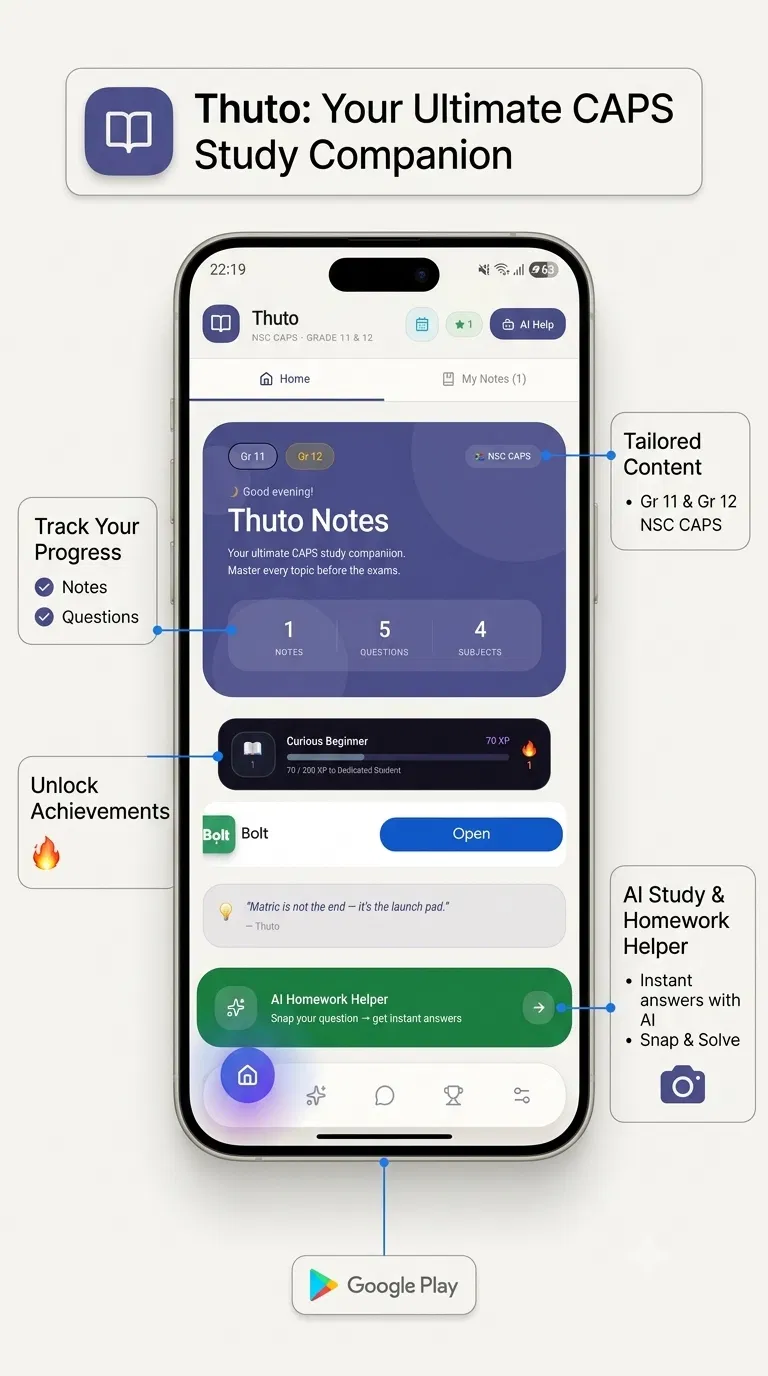
Thuto Notes isn't a chatbot in a school skin. It's a purpose-built exam preparation system with four pillars, each modelled on how learners actually earn marks in the NSC.
Pick a subject and topic, get a full CAPS note in under a minute — mirrored on the real DBE paper and memo for that subject, not a generic textbook summary.
Photograph any question — handwritten, printed, an equation, a diagram — and get a full worked solution that states the rule, shows every step, and checks itself.
The couch teaches you content. It doesn't teach you to perform under pressure. Exam Challenge turns your screen into a real, timed NSC sitting — the way November actually feels.
Turn every note into flashcards, plan your study around real exam dates, and let streaks reward the one thing that predicts matric results most: showing up consistently.
Practising a past paper on the couch teaches you the work. It doesn't teach you to hold your nerve when the clock is real. So the whole screen becomes the exam.
Pen and paper ready, quiet room, phone silenced, three deep breaths.
A 3 · 2 · 1 countdown starts the paper. No going back.
Last ten minutes turn amber. The final two minutes pulse red.
At 00:00 the screen locks — exactly as an invigilator would call it.
Only now can you mark your own work, honestly, against the official memorandum.
Thuto Notes isn't a global app localised for Africa. Every layer of it — curriculum, content, language, even the cryptography — was built for a specific learner on a specific phone in a specific country.
Built against the CAPS curriculum and NSC standard — including DBE mark descriptors and marking-guideline vocabulary.
Sourced from official DBE and Western Cape Education Department past papers and memoranda — the real thing, not a summary.
Afrikaans (Eerste Addisionele Taal) notes are generated in Afrikaans from the start — not machine-translated after the fact.
Cache-first architecture. A paper is fetched once, then opens instantly with zero signal and zero further data cost.
Engineered for the cheapest phones — down to a hand-written cryptography layer for a platform bug found, diagnosed and fixed solo.
Funded by ads placed only at genuine breaks — so the learner who needs it most pays nothing, ever.
The easiest app to build would do learners' homework for them. Thuto Notes deliberately does the opposite — it teaches method so you can reproduce it in the exam, and always points you back to your teacher and the official marking guidelines.
It states the rule before applying it and shows every step, so you learn to do it yourself.
“Write my assignment for me” requests are explicitly refused. It won't make your work disappear.
Ask about gossip, sports scores or anything off-syllabus and it declines. It stays on the curriculum.
Prompt-injection and jailbreak attempts are filtered before they ever reach the model.
Every line of Thuto Notes — the product, the design, the app, the backend, the security layer, the content pipeline — was built by one 20-year-old in Soshanguve, Pretoria. No team, no agency, no funding round.
It was built by someone who knows exactly what it feels like to face a syllabus you're expected to master with no resources to master it with. So he built the resources. For us.
“Not the exception to the problem — the product of it.”
Every one of those decisions made, debugged and shipped by one person.
Real past papers, six subjects, an exam hall in your pocket — on the cheapest phone you own, with no data, at any hour of the night.
Get it onGoogle PlayFree forever · No sign-up wall · Works offline